Wildfires in Space
Toward the First Human-Created Extraterrestrial Environmental Crisis

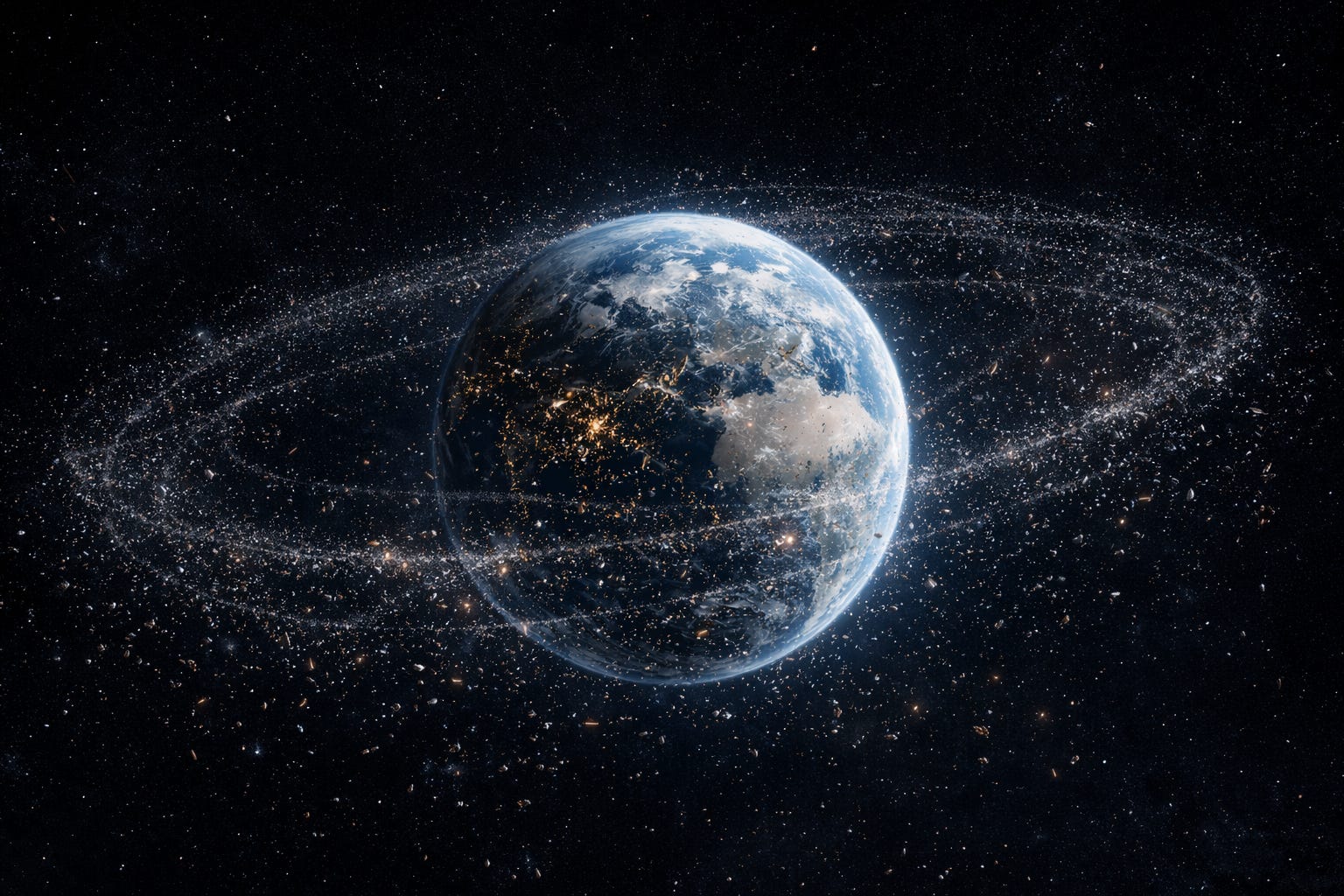
Part I — Orbit as Environment
There is a plausible failure mode for modern civilisation that does not begin with a terrestrial drought, a financial crash, or a conventional war. It begins in low Earth orbit.
Global navigation satellite systems drift by microseconds. Civil aviation routing, which relies on continuous satellite positioning updates, becomes less precise. Weather prediction models degrade as real-time data streams from polar-orbiting satellites are interrupted. Financial networks that depend on high-accuracy time signals from space experience subtle desynchronisation. Military early-warning architectures lose coverage continuity. Emergency response systems that depend on satellite communications experience regional gaps. None of these disruptions initially presents as a singular catastrophe. They register instead as anomalies, delays, and unexplained degradations.
The mechanism for such a scenario has been discussed in the scientific literature for nearly half a century. In 1978, NASA scientist Donald J. Kessler, together with Burton Cour-Palais, published a paper in the Journal of Geophysical Research describing the possibility of a self-sustaining cascade of collisions in Earth orbit. Their analysis suggested that once the spatial density of objects in certain orbital bands exceeds a critical threshold, collisions would generate debris fragments at a rate faster than atmospheric drag could remove them. In that regime, even if no new satellites were launched, the debris environment could continue to deteriorate.
This phenomenon is now commonly referred to as the Kessler Syndrome. The term describes a nonlinear transition in system behaviour. Below a certain object density, collisions are rare and largely independent. Above it, each collision increases the probability of subsequent collisions. The process acquires internal momentum.
The concept parallels the physics of supercritical systems. A system becomes supercritical when each destructive event produces sufficient secondary events to sustain the process without external input. Nuclear chain reactions and epidemic outbreaks follow this logic. Orbital debris dynamics can as well.
For much of the space age, this risk appeared remote. Between 1957 and the late twentieth century, satellites were expensive, sparse, and long-lived. Following the launch of Sputnik 1 in October 1957, space was treated as a strategic domain rather than an ecological one. Objects were counted in the hundreds, not the tens of thousands. Orbital altitude regimes seemed effectively infinite relative to human activity.
The inflection point in satellite growth is recent and quantifiable. For most of the space age, annual launch rates were modest. In 1990 there were roughly 2,000 tracked objects in orbit, of which fewer than 700 were operational satellites. Through the 2000s, the total number of active satellites remained under 1,000. As late as 2013, there were approximately 1,000–1,100 operational satellites globally. The acceleration begins in the mid-2010s. Reusable launch vehicles entered commercial service in 2015, sharply reducing cost per kilogram to orbit and enabling higher launch cadence. In 2018, large commercial broadband constellations began deployment at scale. By the end of 2019, the number of active satellites had risen to roughly 2,200. By the end of 2021, it exceeded 4,800. By 2023, it surpassed 7,500, with the majority concentrated in low Earth orbit below 2,000 kilometres.
Regulatory filings submitted to the U.S. Federal Communications Commission and the International Telecommunication Union contemplate constellations that, if fully deployed, would raise the total number of operational satellites into the tens of thousands. More satellites have been launched in the last five to seven years than in the preceding six decades combined. As this population has expanded, so too has structural dependence: navigation, telecommunications, weather forecasting, financial time-stamping, logistics optimisation, precision agriculture, and military command-and-control systems now rely on uninterrupted orbital services in ways that were marginal or nonexistent a generation ago.
The transformation is not merely quantitative but structural. Satellites are increasingly designed with shorter operational lifetimes—often five to seven years—after which they are replaced. Orbital space has shifted from a frontier of exploration to a continuously refreshed industrial layer surrounding the planet. It is, functionally, infrastructure.
Infrastructure exists within environments. And environments can accumulate stress.
Part II — Suppression, Accumulation, and Phase Change
A common framing of orbital collision risk treats the problem as congestion management. More satellites produce more conjunction warnings. More conjunctions require better tracking and manoeuvring. The response appears straightforward: improve space situational awareness, enhance coordination protocols, and mandate end-of-life disposal.
These measures are necessary. They may not be sufficient.
Risk in complex systems does not increase linearly. It can accumulate silently until thresholds are crossed. To understand this dynamic, it is instructive to examine a terrestrial analogue: twentieth-century wildfire management in the United States.
Following a series of catastrophic fires in the early twentieth century—most notably the 1910 “Big Blowup” that burned approximately three million acres across Idaho and Montana and killed at least 87 people—the U.S. Forest Service adopted an aggressive suppression doctrine. Fire was classified as an adversary. By the 1930s, the agency formalised the “10 a.m. policy”: every reported wildfire was to be contained by 10 a.m. the following day.
For decades, this approach appeared effective. Annual acreage burned declined in many regions. Timber assets were protected. Expanding suburban developments in fire-prone landscapes felt secure. Public campaigns reinforced the message that fire was a preventable failure of management.
What this doctrine neglected was ecological function. In many North American forest ecosystems—particularly ponderosa pine forests in the West—low-intensity surface fires historically occurred at regular intervals. These fires reduced accumulated dead biomass, limited understory growth, and maintained spatial heterogeneity.
Systematic suppression altered that regime. By preventing smaller, frequent burns, land managers inadvertently allowed combustible material to accumulate. Forest stands became denser. Fuel continuity increased. When ignition eventually occurred—often under hotter and drier climatic conditions amplified by anthropogenic climate change—fires burned with greater intensity and moved into forest canopies, producing large, fast-moving crown fires.
By the late twentieth and early twenty-first centuries, wildfire researchers documented a paradox: fewer ignitions in some regions, but significantly larger and more destructive fires. In November 2018, the Camp Fire destroyed the town of Paradise, California, killing 85 people and becoming the deadliest wildfire in California’s recorded history. The event exposed the limits of suppression-only doctrine.
The doctrinal shift that followed reframed fire as a process to be managed rather than eliminated. Prescribed burns, mechanical thinning, and fuel breaks were reintroduced as risk-reduction strategies. The lesson was not that fire had become more aggressive in essence, but that system structure had changed under accumulated fuel loads.
Orbital debris dynamics exhibit analogous structural features.
Satellite collisions do not merely remove two spacecraft from operation. They generate fragmentation clouds containing thousands of trackable fragments and potentially many more sub-centimetre particles. Some fragments remain in orbit for decades, depending on altitude and atmospheric drag. Each fragment becomes a new potential collision agent.
Certain historical events illustrate the scale of this risk. In January 2007, China conducted an anti-satellite test that destroyed the Fengyun-1C weather satellite at approximately 865 kilometres altitude, creating more than 3,000 trackable debris objects. In February 2009, the operational Iridium-33 satellite collided with the defunct Russian Cosmos-2251 satellite at roughly 790 kilometres, producing another large debris field. These events significantly increased object density in heavily used orbital bands.
Collision avoidance manoeuvres reduce the probability of immediate impact between intact satellites. They do not eliminate existing debris mass. Defunct satellites and abandoned rocket bodies function as latent risk reservoirs, analogous to accumulated forest fuel. Fragmentation events function as ignition events. Debris fragments behave like embers dispersed across orbital regions.
If debris density crosses a critical threshold, collisions can begin to propagate without additional launches. The system shifts from isolated accidents to a supercritical cascade in which instability feeds on itself.
The threshold behaviour is not merely conceptual. Even in simplified shell models of a 500–600 km low Earth orbit band, the mathematics is stark. Collision frequency scales with the square of object density, meaning small increases in intact mass can produce disproportionately large increases in catastrophic collisions. When fragmentation yield, fragment lifetime, and orbital mixing are incorporated into a branching-process framework, a reproduction number emerges: if each catastrophic breakup generates, on average, more than one additional catastrophic collision before fragments decay, the system becomes supercritical. Under constructed but physically plausible parameters—high object density, multi-decade fragment persistence, and fragmentation events producing thousands of lethal fragments—the reproduction number rises well above one, implying runaway cascade behaviour in expectation.
In exploratory modelling, that supercritical boundary can emerge once intact populations reach on the order of tens of thousands within a single altitude shell, particularly when derelict mass accumulates and fragment lifetimes extend into decades. The structural insight is not that cascade is inevitable today, but that there exists a definable boundary condition: density × persistence × mixing × fragment yield must remain below a critical threshold. Cross it, and collision generation becomes self-sustaining.
Part III — Recognising a New Category of Environmental Risk
Wildfire science required decades to move from suppression orthodoxy to resilience-based management. Crucially, that transition accelerated only after catastrophic fires demonstrated the limits of prevention.
Orbital governance may be standing at a similar threshold.
The wildfire analogy explains how orbital instability can emerge. The ocean analogy explains why preventing it is politically difficult.
The governance problem resembles the challenge of managing the open seas. For centuries, the oceans were treated as effectively boundless. Over time, however, overfishing, pollution, shipping congestion, and resource extraction revealed that the high seas function as a shared commons—vast, but not infinite. No single state controls them. Jurisdiction is layered and fragmented. Enforcement is uneven. Incentives often favour short-term exploitation over long-term stewardship.
Today, ocean governance rests on a dense web of international law: the 1982 United Nations Convention on the Law of the Sea alone is supplemented by dozens of implementing agreements, regional fisheries management organisations, maritime safety conventions, environmental protocols, and bilateral treaties—amounting to well over a hundred overlapping legal instruments. Even so, illegal fishing, plastic accumulation, and contested maritime claims persist, demonstrating the difficulty of governing a borderless domain.
Low Earth orbit exhibits similar structural features. It is physically finite but politically fragmented. Launch authority is national, but debris consequences are global. Economic incentives reward rapid deployment, while environmental costs are diffused across all operators. Like the oceans, orbit is not owned—but it can be degraded.
Current orbital debris policy focuses heavily on prevention. Tracking systems are improving. Collision avoidance manoeuvres are becoming more sophisticated. Operators coordinate more effectively than ever before. These developments are essential for operational safety.
But they do not necessarily address long-term environmental stability.
The debris environment in low Earth orbit continues to evolve. Launch rates are rising. Constellations are expanding. Derelict mass is accumulating. Fragmentation events periodically inject large debris clouds into orbital bands. Yet the system continues functioning well enough to avoid widespread alarm.
The deeper danger is not that satellites might collide. It is that orbit itself could become an evolving environment shaped by human-generated instability. If cascade thresholds are crossed in heavily used orbital regions, the consequences could persist for decades, disrupting global communications, navigation, climate monitoring, and security infrastructure.
This possibility introduces a new category of environmental challenge. Historically, human environmental crises have occurred on Earth: climate change, biodiversity loss, ocean pollution, and deforestation. Orbital debris introduces something unprecedented.
It may represent the first human-created extraterrestrial environmental crisis.
Unlike terrestrial ecosystems, orbital environments do not regenerate naturally. Debris removal is technologically complex and economically expensive. Once cascade dynamics emerge, restoring orbital stability could become extraordinarily difficult.
The most important question may not be whether cascade events are possible. The more important question may be whether we are recognising the nature of the system early enough to respond.
Wildfire science teaches that environmental tipping points are rarely recognised in advance. They are usually understood only after catastrophic disturbances expose the underlying dynamics.
Civilisations rarely fail because they lack technology. They fail because they misdiagnose the systems they inhabit.
The central question facing space is no longer whether orbit can be used. It is whether orbit can remain a stable environment for human civilisation. And that question forces a philosophical shift. Space is not empty territory. It is becoming a shared environment with thresholds, feedback loops, and limits.
The real danger is not that the sky might fall.
It is that the sky might quietly begin to burn.